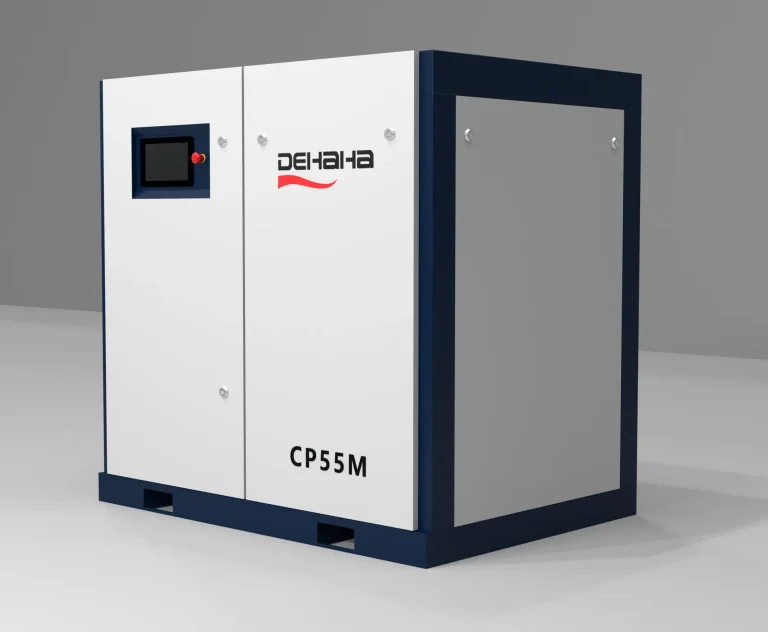
In textile manufacturing, compressed air is widely used for air-jet looms, pneumatic control equipment, automated production lines, and other pneumatic systems. Air-jet looms, in particular, have stringent requirements for both airflow volume and pressure stability.
Improper air compressor sizing can lead to insufficient air supply and unstable equipment operation, or conversely, severe energy waste. So, what size compressor de ar de parafuso should a textile mill choose? The answer requires a comprehensive assessment of production scale, equipment quantity, and actual air consumption.
1. Why Are Screw Air Compressors Ideal for Textile Mills?
Textile factories typically require long-term, continuous operation. Some production lines run for extended hours daily, demanding highly stable compressed air supply.
Compared to traditional piston compressors, screw air compressors are better suited for many continuous-use industrial scenarios. Their main advantages include:
- Continuous Air Supply: Ideal for prolonged operation, providing a stable air source for multiple production machines.
- Stable Operation: Helps minimize the impact of pressure fluctuations on production equipment.
- Relatively Low Noise: Contributes to a better working environment.
- Manutenção fácil: Modular design facilitates daily inspections and maintenance.
- Energy-Efficient Options: Variable Speed Drive (VSD) screw compressors are highly recommended for factories with fluctuating air demand.
2. What Horsepower (kW) Screw Air Compressor Does a Textile Mill Need?
There is no universal standard for air compressor sizing in textile mills. Common power ratings range from 15 kW, 22 kW, 37 kW, 55 kW, and 75 kW, up to larger capacities, depending on the number of production machines and total air demand.
Factories of different scales can refer to the following guidelines:
- Small-Scale Textile Mills: If the number of production machines is limited and overall air demand is low, a 15–22 kW screw air compressor may be suitable. Actual sizing requires calculating the total air consumption during simultaneous operation.
- Medium-Scale Textile Mills: For factories with multiple air-jet looms and auxiliary pneumatic equipment, 22–55 kW models are recommended, or multiple compressors can be combined to meet specific demands.
- Large-Scale Textile Mills: For large factories with numerous machines and continuous production lines, 55–75 kW or larger compressors may be required. Alternatively, multiple units can be operated in parallel to enhance supply flexibility and system reliability.
Nota: The above power ratings are preliminary references only and do not represent fixed equipment-to-capacity ratios. Final selection must be based on actual FAD (Free Air Delivery), working pressure, and air load.
3. Key Parameters to Consider When Selecting Air Compressors for Textile Mills
When choosing a screw air compressor, do not look at motor power alone. Pay close attention to the following aspects:
- Air Flow (FAD): Airflow is a critical sizing metric. Calculate the air consumption of air-jet looms, pneumatic equipment, and other users, factoring in the simultaneous usage rate and peak production demands. Always verify the actual FAD at the specified pressure to prevent production disruptions due to insufficient air.
- Pressão de trabalho: Different textile machines have varying pressure requirements. For air-jet looms, always refer to the manufacturer’s specified inlet pressure and account for pressure drops caused by pipelines, filters, and dryers.
- Air Quality: Moisture, oil mist, and particulate matter in compressed air can severely impact pneumatic equipment and production processes. Textile mills should configure air receivers, refrigerated air dryers, and precision filters according to equipment requirements. If the process demands stricter pressure dew points or air cleanliness, desiccant air dryers should be considered.
- Operating Hours: For textile mills operating around the clock, beyond the initial purchase cost, prioritize energy consumption, maintenance cycles, spare parts availability, and long-term operational reliability.
4. Fixed Speed vs. Variable Speed Drive (VSD) Screw Air Compressors
Both fixed-speed and VSD models have their specific application scenarios.
- Fixed-Speed Screw Air Compressors: Best suited for textile production lines with relatively stable air demand and long-term high-load operation. They feature simple control systems that easily meet continuous supply needs.
- Variable Speed Drive (VSD) Screw Air Compressors: Ideal for factories where air demand fluctuates significantly due to shift changes, equipment start/stop cycles, or varying production loads. VSD technology adjusts motor speed based on real-time demand, offering substantial energy-saving potential during partial-load operation.
Summary: If air demand is consistently stable, fixed-speed models may be more appropriate. If fluctuations are significant, evaluate the energy-saving benefits of VSD models.
5. How to Improve the Efficiency of Compressed Air Systems in Textile Mills
Beyond selecting the right air compressor, focus on the entire compressed air system:
- Design main and branch pipelines rationally to minimize unnecessary pressure drops.
- Regularly inspect pipelines, joints, and valves to prevent compressed air leaks.
- Configure drying and filtration equipment based on air quality requirements.
- Clean or replace air filters regularly and inspect the cooling system.
- For large factories, consider centralized control systems for multiple compressors to adjust operation based on real-time demand.
A well-designed system configuration not only ensures stable air supply but also significantly reduces long-term operating costs.
The key to selecting the right screw air compressor for a textile mill is not simply “the bigger, the better.” It lies in matching the FAD, working pressure, and actual air demand perfectly. Whether for a small workshop or a large factory with multiple air-jet loom lines, a tailored compressed air solution should be developed based on equipment quantity, operating hours, and air quality requirements.
Looking for a Reliable Screw Air Compressor Manufacturer?
Bem-vindo ao Contactos! Based on your factory scale, equipment count, and air requirements, we can provide suitable compressor models, VSD solutions, and complete supporting systems. We also fully support overseas distributors and OEM partnerships.